Clean water is becoming increasingly scarce, yet most hydrogen production still depends on it. Sea4Volt, a Horizon Europe project co-funded by the European Union and the Clean Hydrogen Partnership, takes on this challenge by developing a new type of low-temperature Anion Exchange Membrane electrolyser that produces green hydrogen directly from seawater.
Using PFAS-free membranes, corrosion-resistant materials, and cost-effective components, the system operates efficiently and durably under a slight pH-gradient.
Tested with seawater from the Atlantic, Mediterranean, and Baltic, Sea4Volt also explores brine valorisation, turning by-products into resources and enabling sustainable hydrogen production without competing with freshwater.

Sea4Volt explores how seawater interacts with electrolyser materials at their interfaces. By combining advanced simulations and experiments, the project aims to understand and prevent corrosion and degradation, improving the long-term stability and efficiency of seawater electrolysis.
Computational tools and resources including training databases with DFT data, MLP models trained from them and the structural models of nanoporous media.
Machine learning models based on high-throughput computational campaigns.
Sea4Volt develops corrosion-resistant and affordable cathodes that perform reliably in seawater. Using advanced computer modelling and experiments, the project designs Platinum Group Metal (PGM)-free and lean HER electrocatalysts with protective coatings that prevent contamination and degradation.
Low-PGM (< 0.4 mg/W) HER electrocatalysts with semipermeable coatings to suppress poisoning and increase durability.
Abundant-material-based HER catalysts for seawater electrolysis.
Mass-transfer-optimised CCS or CCM made of PGM-free or PGM-lean electrocatalysts with semipermeable coatings to suppress poisoning.
Sea4Volt integrates its newly developed materials into a multi-cell electrolyser stack to test efficiency and durability in real seawater conditions. Building on experience from previous projects, the stack will demonstrate stable hydrogen production and provide valuable data for performance and techno-economic analysis.
Novel electrolyser single-cell assembly and stack design.
Corrosion-resistant flow field plates for direct seawater electrolysis
Sea4Volt develops harmonised testing protocols to assess how AEM electrolysers perform with pH-gradient seawater feeds. By defining artificial seawater compositions that mimic the Atlantic and Mediterranean, the project ensures reliable, EU-aligned benchmarking for the performance and durability of seawater electrolysers.
Membranes and MEAs with protective coatings.
Abundant-material-based OER catalysts with tolerance against impurities.
Sea4Volt explores how the electrolyser can be integrated into a zero-liquid-discharge system that reuses or recovers minerals from seawater brine. By comparing different electrolyte options, the project aims to turn by-products into resources, supporting circular and sustainable hydrogen production
Flow-sheet design for integrated seawater electrolysis and brine treatment.
Sea4Volt aims to build strong collaborations with other EU-funded initiatives working on clean hydrogen and seawater electrolysis. Through joint workshops, knowledge exchange, and community events, the project seeks to maximise impact and share best practices across Europe.
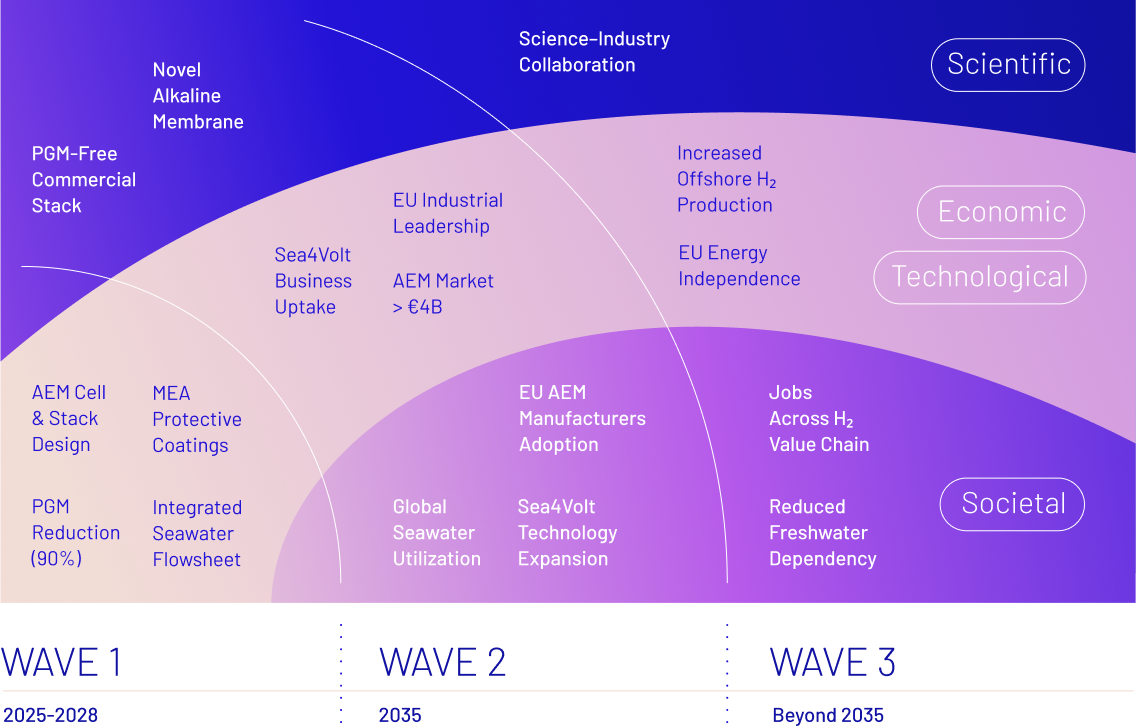
Sea4Volt results aim to create a ripple of impact – advancing science, enabling new technologies, and driving economic and societal progress across Europe