
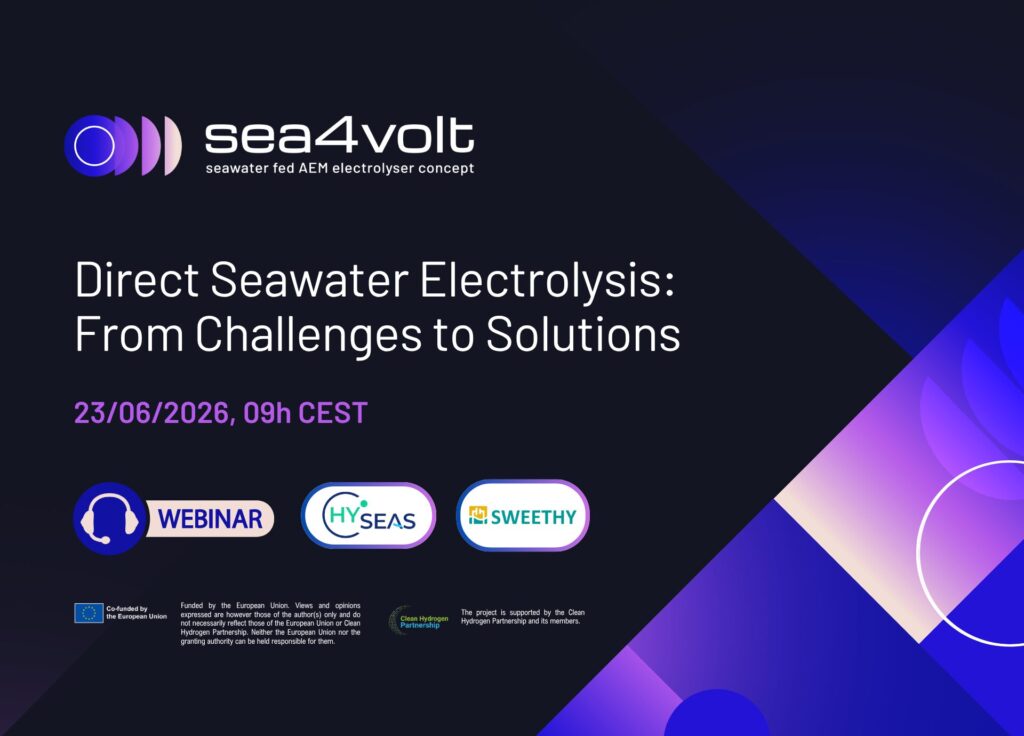
The ocean offers vast potential for sustainable hydrogen production. Yet, turning seawater into a reliable source of clean hydrogen is far from straightforward. Salts, impurities, and harsh operating conditions pose significant challenges to developing electrolysers that are efficient, durable, and scalable.
Bringing together the EU-funded sister projects Sea4Volt, HySEAS, and SWEETHY, this webinar explores how researchers are addressing these barriers and advancing direct seawater hydrogen production toward real-world deployment.
By joining this session, you will gain insights into the following challenges:
Corrosion, Selectivity & System Efficiency
Sea4Volt will explore how its low-temperature AEM electrolyser approach addresses corrosion, competing chlorine evolution reactions, and efficiency challenges in direct seawater hydrogen production.
Materials & System Durability
HySEAS and SWEETHY will explore how their innovations in bipolar membrane electrolysers, advanced membranes, catalysts, and cell stack components help withstand degradation and support long-term operation in harsh seawater conditions.
The session will continue with a joint panel discussion, opening the floor for exchange on shared challenges, different perspectives, and the next steps toward making direct seawater hydrogen production a viable reality at industry scale. Have a question for our speakers? Join the live Q&A and be part of the conversation.
Moderators
Farhan Ali, Research Scientist, VTT (Sea4Volt Project Coordinator)
Milana Sekulic, Communication Manager, F6S (Sea4Volt)
Speakers
Sasscha Morlock ,Research Scientist, Fraunhofer IFAM (Sea4Volt)
Dr Yagya N. Regmi ,Reader in Energy Conversion and Storage, Manchester Metropolitan University (HySEAS)
Julien Fage ,Polymer Chemist, CENmat (SWEETHY)
Olesia Danyliv ,Researcher at RISE Research Institutes of Sweden (SWEETHY Project Coordinator)
See you soon!
 Tuesday, 23 June 2026.
 09:00 – 10:30 CEST (Brussels)
📍Online (Zoom)